

CT
This is possible for your pet, too!

What is CT?
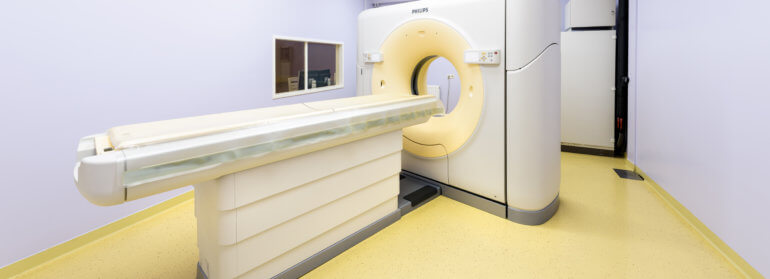
CT (Computed Tomography) is an imaging technique that uses X-rays to examine the body. An X-ray tube rotates at high speed around the tunnel through which the patient moves. The tube emits a narrow beam of radiation through the body, which is detected on the opposite side by a detector. Our system (64-slice) contains 64 of these detectors, allowing for the rapid acquisition of very high-resolution images. The scanner scans a defined part of the body in a large number of slices, after which cross-sections can be created in any desired direction, as well as a 3D image of the scanned area.
Safety
A CT scanner uses X-rays. For this reason, you cannot be with your pet during the exam. The scan itself takes only a short time—usually just a few minutes—after which your pet will be removed from the scanner. While the exam is in progress, you are welcome to have a cup of coffee or tea in the waiting room.
Why CT?
Any pet owner who takes a sick animal to the vet is, in principle, interested in only three things:
1. What’s wrong with him? (Diagnosis)
2. What are the chances of recovery? (Prognosis)
3. What can be done about it? (Treatment)
It should be clear that questions two and three cannot be answered properly without a diagnosis.
It is still quite common for a definitive diagnosis to be impossible using standard imaging techniques such as X-rays and ultrasound. In many cases, a CT scan can provide a solution. Sometimes an MRI is a better option.
Anesthesia
If you schedule a CT scan with us, this means your pet will need to be anesthetized. During the exam, he or she must not move at all. Proper preparation for an examination under anesthesia begins at home. The day before the procedure, your pet must not eat anything after 6:00 p.m. Water is allowed, though! The next day, please come to the clinic at the scheduled time. Please walk your dog beforehand! When you bring your pet to us, you do so with the (justified) expectation that he or she will receive the best possible medical care. That is why we always perform a physical examination before the animal is put to sleep. In particular, we pay close attention to the heart and lungs. If you are visiting us on referral from another veterinarian, it would be helpful if you could bring your pet’s medical history (including any blood test results and/or X-rays). Just as in human medicine, anesthetics used in veterinary medicine are very safe. The risks of anesthesia are therefore minimal for a healthy animal. However, if there are any health issues (unknown to you or us), anesthesia may pose certain risks. If the pre-anesthesia examination reveals no abnormalities, our team can safely anesthetize your pet and begin the examination. The pet is continuously monitored during anesthesia. After the examination is complete, the pet is woken up and, as a rule, can go home immediately.
After the investigation
Once the animal’s examination is complete, the results and the images obtained must be evaluated. Often, a diagnosis can be made immediately after the examination. If necessary, images are submitted for further evaluation to experts in the field of medical imaging: Dr. I. Gielen and Prof. H. van Bree of Ghent University. We then propose a treatment plan.
If you are visiting us based on a referral from your own veterinarian, we will refer you back to them and send your veterinarian a report from us as soon as possible (by phone, mail, fax, or email), so that once you are back home, you can work with him or her to develop a plan for further treatment.
When to Use a CT Scan and When to Use an MRI?
For some conditions, an MRI is the best way to reach a diagnosis; for others, a CT scan is.
Click HERE to see an overview of which research method is best.