
Tarsus

Osteochondrosis dissecans (OCD)
Osteochondrosis (OC) is caused by a disruption of enchondral ossification in the articular-epiphyseal complex. Nutrition plays an important role as an etiological factor. The condition is referred to as osteochondrosis dissecans (OCD) when loose pieces of cartilage or bone become lodged in the joint.
OCD is primarily seen in dogs at four sites: the caudal portion of the humeral head, the medial humeral condyle, the lateral femoral condyle, and the medial talar crest. OCD is the most common cause of tarsal problems. OCD is often seen in young dogs of large(r) breeds starting at 4–6 months of age.
CASE: Bo, a 4-year-old golden retriever, is limping on his left hind leg
During Bo’s clinical examination, it is noted that her left tarsus is thickened.
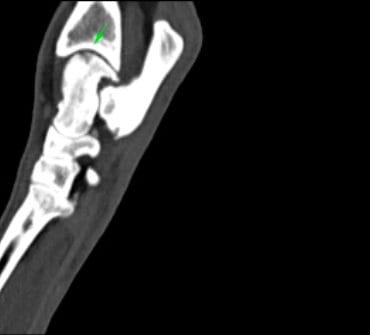
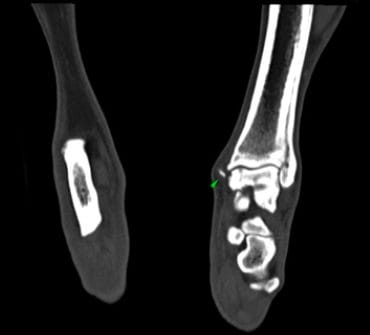
An X-ray reveals an OCD lesion of the medial talar crest.
Although the diagnosis had already been made, a CT scan of the tarsus was performed at the surgeon’s request to determine the extent of the lesion, its location relative to the medial collateral ligament, and, consequently, the best approach for treating the lesion. (Images in the banner on this page)
Bo underwent surgery to remove the loose fragment. His recovery went well, despite his pre-existing osteoarthritis.