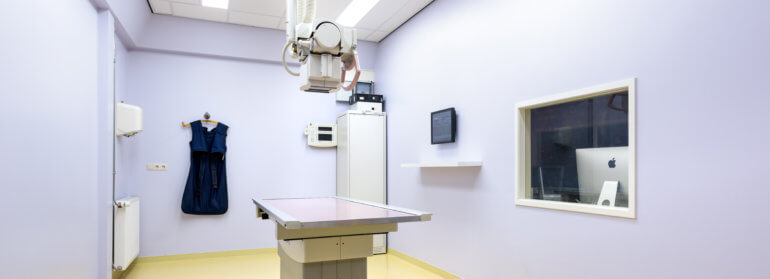

Radiology
The X-ray
X-rays are the oldest form of medical imaging. Since then, many other types of medical imaging have been developed, such as ultrasound, endoscopy, CT, MRI, and scintigraphy.
X-rays remain an indispensable tool for detecting all kinds of conditions.
X-rays are also used for a number of health screenings in purebred dogs: the official HD and ED screenings.
The Official Hip Dysplasia Screening
The official HD screening must be performed by a veterinarian who has entered into an agreement with the Raad van Beheer for this purpose. At our clinic, several veterinarians are authorized to perform this screening.
In principle, all purebred dogs (with a pedigree registered in the current owner’s name!) can be examined starting at 12 months of age. However, the following (large) breeds can only be examined starting at 18 months of age: Maremma Sheepdog, Bullmastiff, Landseer, Mastiff, Newfoundland, Saint Bernard, Bordeaux Dog, Great Dane, Leonberger, Neapolitan Mastiff, Pyrenean Mountain Dog.
To take the HD X-ray, the dog must be placed on its back on the X-ray table. Some dogs allow this without sedation, but often they must be sedated first, especially because the evaluation committee (rightly) sets high standards for the technical quality of the HD X-ray. For example, the dog’s pelvis and legs must be depicted completely symmetrically, the kneecaps must be sufficiently “rotated inward,” the exposure of the image must be exactly right, and so on. While the image is being taken, the pedigree number, HD number, and veterinarian code are added to the digital image.
Prior to the examination, the owner must first create a one-time account (as a breeder) on the Raad van Beheer website. The results will be sent to this account; they will no longer be sent by mail. The veterinarian will send the photo to the Raad van Beheer, GGW department. Since May 23, 2016, the assessment fees must be paid directly to the veterinarian. The Raad van Beheer therefore no longer sends an invoice for this assessment but settles the payment directly with the veterinarian.
The Official Elbow Dysplasia Study
The official ED examination must be performed by a veterinarian who has entered into an agreement with the Raad van Beheer for this purpose. At our clinic, several veterinarians are authorized to perform this examination.In principle, all purebred dogs (with a pedigree registered in the current owner’s name!) can be examined starting at 18 months of age. The following breeds can be examined starting at 12 months of age: Labrador Retriever, Golden Retriever, Nova Scotia Duck Tolling Retriever, Flat-Coated Retriever, German Shepherd, and Bouvier des Flandres.
For certain breeds, a so-called “diagnostic examination” is required, which means that 4 images must be taken per elbow, for a total of 8 images. These breeds are: Labrador Retriever, Golden Retriever, Rottweiler, Bernese Mountain Dog, German Shepherd, and Bordeaux Dog. For all other breeds, the osteoarthritis examination is sufficient (2 images per elbow).
To take the ED X-rays (i.e., 4 or 8 images), the dog must be positioned on its side on the X-ray table. Some dogs allow this without sedation, but in almost all cases they must be sedated first, especially since the
evaluation committee (rightly) sets high standards for the technical quality of the ED images. While the images are being taken, the pedigree number, ED number, and veterinarian code are added to the digital images.
Before the examination, the owner must first create a one-time account (as a breeder) on the Raad van Beheer website. The results will be sent to this account; they will no longer be sent by mail. The veterinarian will send the photos to the Raad van Beheer, GGW department.